SEO
How Does Google Find Your Website? 7 SEO Basics for Businesses
How can you make your business website easier to find on Google? Discover 7 essential SEO basics that can improve your website's visibility and help attract potential customers.
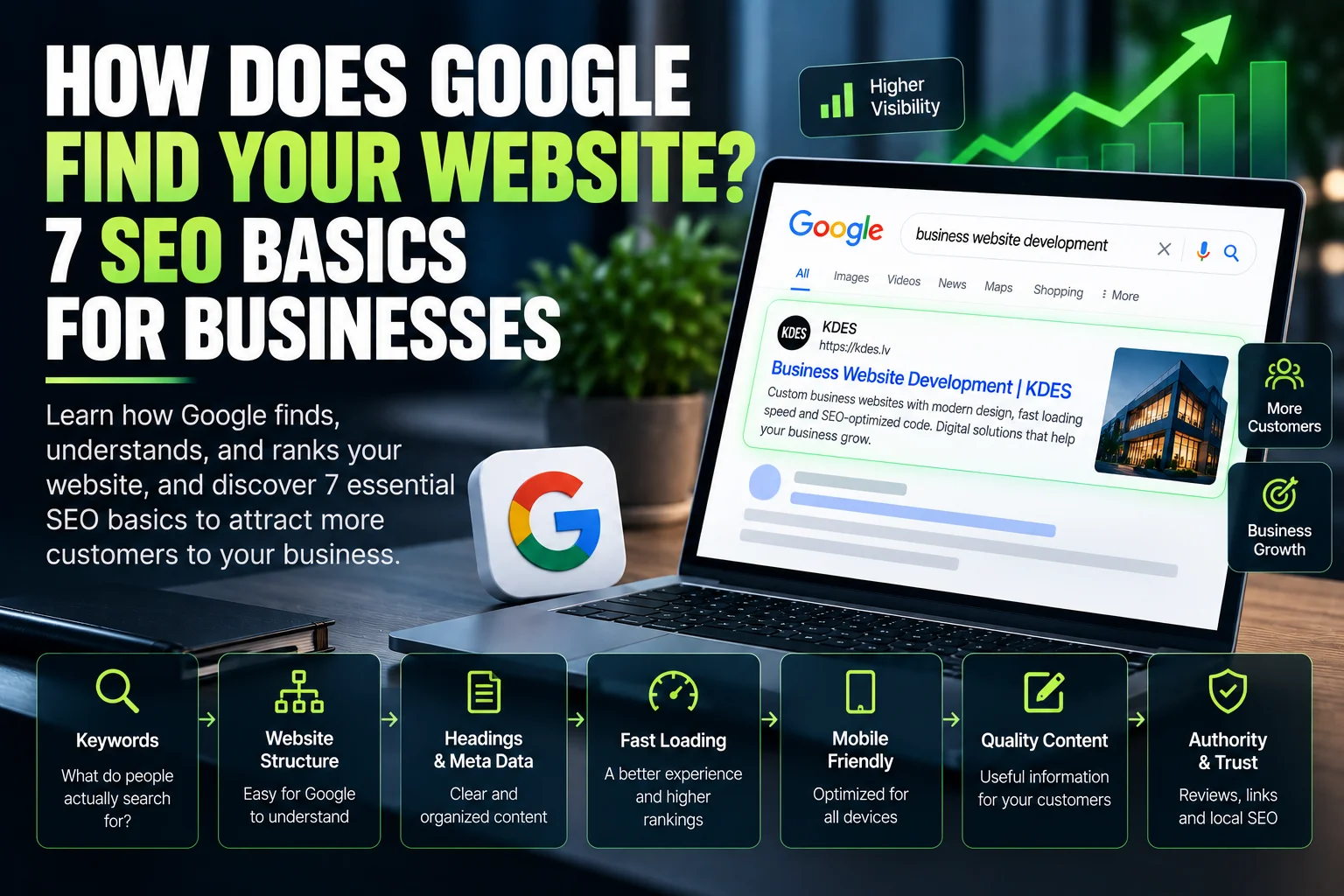
A great website isn't enough if potential customers can't find it. If your business doesn't appear when people search for your products or services on Google, a large part of your website's potential remains unused.
Whether you run a small local business, provide professional services, or operate a growing e-commerce company, many potential customers begin their search on Google. That's why it's important not only to build a website, but also to make sure search engines can understand it.
But how does Google understand what your website is about, and why does one website appear higher in search results than another?
This is where SEO, or search engine optimization, comes in.
What Is SEO?
SEO (Search Engine Optimization) is the process of improving a website's visibility in organic search results.
In simple terms, SEO helps Google understand:
- what your website is about;
- which products or services you offer;
- which people your content is useful for;
- whether your website is technically well built;
- whether your content is relevant and trustworthy for a particular search.
SEO isn't a single button you can turn on. It is a combination of technical, content, and authority-related factors that work together over time.
1. Choose the Right Keywords
Before optimizing your website, you need to understand what your potential customers are actually searching for.
For example, a company that develops websites might want to appear for searches such as:
- website development;
- website design and development;
- business website development;
- e-commerce website development;
- professional business website;
- website development cost.
However, there is no need to repeat one keyword dozens of times throughout a page.
Google is increasingly capable of understanding context and search intent. The goal should therefore be to create content that genuinely answers the user's question.
A good SEO strategy starts with a simple question: "What does my potential customer search for before they become my customer?"
2. Build a Clear Website Structure
Google needs to understand how your website is organized.
If every topic is mixed together on a single page, it becomes harder for search engines to determine which content answers a particular search query.
A professional business website will often benefit from a clear structure such as:
- Home;
- About Us;
- Services;
- individual service pages;
- Portfolio or Projects;
- Blog or Resources;
- Contact.
This structure isn't only useful for Google. It also helps visitors find the information they need more quickly.
Good SEO and good user experience often start with the same thing: a clear structure.
3. Use Proper Headings and HTML Structure
Website content isn't only about the text visitors see on the screen. The way that content is technically structured also matters.
Headings such as <h1>, <h2>, and <h3> help organize the content and communicate the relationship between different topics.
Other important elements include well-written meta titles, meta descriptions, semantic HTML, descriptive URLs, and properly implemented image alt attributes.
Visitors may never notice these elements directly, but they form an important part of a technically sound website.
4. Your Website Needs to Be Fast
Nobody wants to wait for a website to load.
Website performance can be affected by:
- image sizes;
- code quality;
- JavaScript and third-party scripts;
- server configuration;
- hosting quality;
- caching;
- the overall amount of resources loaded by the page.
That's why SEO cannot be completely separated from technical website development.
A fast website creates a better experience for visitors and gives your business a stronger technical foundation.
If a website is built with unnecessarily complex code or hosted on unsuitable infrastructure, achieving good performance later can become more difficult.
5. Your Website Must Work Well on Mobile
People use Google from many different devices, especially smartphones.
Your website therefore needs to be responsive, meaning that its content and functionality work properly across different screen sizes.
A mobile version isn't simply a smaller desktop version.
You also need to consider:
- text size;
- button size;
- navigation;
- image dimensions;
- page loading speed;
- forms and interactive elements.
If your website is difficult to use on mobile, visitors may leave before they even discover what your business offers.
6. Publish Useful and High-Quality Content
SEO isn't only about technical optimization.
Google wants to provide users with content that is useful and relevant to their search intent.
That's why businesses should consider creating content that answers the questions their potential customers are asking.
For example, if you provide website development services, potential customers may search for:
- How much does website development cost?
- Does my business need a WordPress website?
- How do I choose a website developer?
- How can I improve my website speed?
- What should a professional business website include?
Each of these questions can become a useful article, guide, or dedicated website section.
Good content doesn't just attract visitors from Google — it also demonstrates your expertise to potential customers.
7. Build a Consistent and Trustworthy Online Presence
Google doesn't evaluate only one individual page. The overall signals surrounding a business can also help establish context and credibility.
Businesses should maintain consistent information about their company name, services, location, and contact details across relevant platforms.
Depending on the type of business, this may also include:
- Google Business Profile;
- customer reviews;
- relevant industry directories;
- quality links and mentions from other websites;
- public project examples;
- active and useful content.
SEO results aren't built overnight. A trustworthy online presence is developed gradually.
Is It Enough to Simply Add Keywords?
No.
SEO isn't about how many times a specific word appears on a page.
If content feels unnatural, repetitive, or is written only for search engines, it can create a poor experience for actual visitors.
A better approach is to write for people while making sure search engines can clearly understand what each page is about.
People first, search engines second.
Why Should SEO Start During Website Development?
One of the most common mistakes is to build a website first and only think about SEO afterwards.
SEO can certainly be improved after a website has launched, but many important decisions are easier to make during development.
For example:
- website architecture;
- URL structure;
- HTML and heading structure;
- loading performance;
- mobile responsiveness;
- image optimization;
- internal linking;
- technical indexing.
When these elements are considered from the beginning, you don't have to rebuild large parts of your website later simply to make it more SEO-friendly.
SEO Isn't Just About Google — It's About Customers
The main goal of SEO isn't simply to generate more clicks.
For a business, what matters is attracting the right visitors — people who are genuinely looking for your products or services.
If someone searches Google for "business website development" and lands on your website, they have already shown an interest in what you offer.
That's why a well-planned SEO strategy can become a long-term customer acquisition channel.
How Can KDES Help?
SEO starts with a strong technical foundation. That's why website development and SEO are often closely connected.
KDES develops custom, SEO-friendly business websites where technical optimization is considered as part of the development process.
We can help with:
- website architecture and structure;
- SEO-friendly HTML and technical structure;
- performance optimization;
- mobile-responsive development;
- meta tags and page structure;
- Google Analytics and Search Console configuration;
- SEO-focused content structure;
- technical website improvements.
If your current website is slow, technically outdated, or wasn't built with SEO principles in mind, sometimes the most effective solution isn't fixing every individual issue — it is to build a new, technically sound foundation.
Is Your Website Ready for Google?
SEO isn't a quick trick that guarantees the first position in Google. It is a long-term process that combines technical quality, useful content, user experience, and a trustworthy online presence.
The earlier SEO is considered during website development, the easier it is to build a strong foundation for future growth.
If you want to build a new website or improve the SEO and technical quality of your existing website, KDES can help.
Tell us about your business and your goals, and we'll help you determine which solution makes the most sense for you.